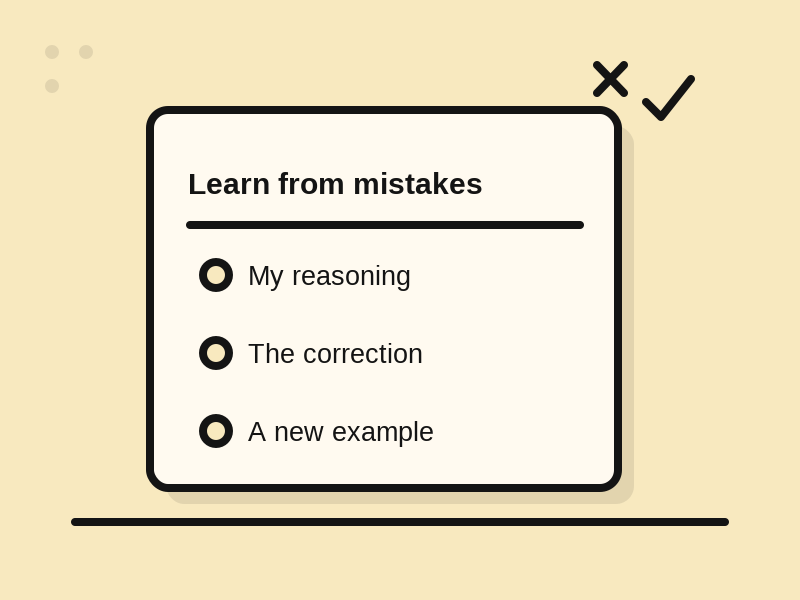
A study mistake log records why an answer went wrong and what you will do differently next time. It is more useful than a page of scores because it shows whether you misunderstood a concept, missed a condition, guessed or made a calculation error.
Keep it small enough to revisit. Log errors that reveal a repeatable problem, along with correct answers you guessed. You do not need to copy every question from a practice session into another document.
A mistake log template to copy
Topic and practice date:
Question reference:
My answer and reasoning:
What went wrong:
Correct reasoning:
Source to check:
A new example:
Next review:
Result of the next attempt:
Write the reasoning in your own words before reading a long explanation. Otherwise it is easy to replace the original misunderstanding with an answer that looks obvious after the fact. The log should preserve enough of the mistake to help you recognise it again.
A worked example
Suppose a question describes a supplier who has already cancelled a delivery. You choose “risk” because you associate all delivery problems with risk management.
What went wrong: I noticed the topic but missed the timing.
Correction: The cancellation is confirmed, so there is a current issue to address.
New example: A venue might close next month versus a venue that has already cancelled our booking.
Next attempt: Explain the difference before seeing answer options.
This correction gives you a decision rule to practise. Writing only “correct answer: C” would not help if the same concept appeared with different option letters.
Separate different causes of error
- Concept gap: You do not understand the underlying idea. Return to the explanation and work through an example.
- Recall gap: You understand it when prompted but cannot retrieve it alone. Add a short recall question.
- Reading error: You missed a condition or a word such as “not”. Practise identifying the exact request before answering.
- Process error: Your method skipped a step. Write and test the missing step.
These labels are a practical way to choose your next action, not a formal diagnosis of how you learn. If a question itself is ambiguous, record that separately rather than forcing your response into an error category.
Review the log actively
At the beginning of a study session, choose a few unresolved entries. Hide the correction and answer the new example. Then check both the answer and the reasoning. Record whether you still needed a hint.
When an entry becomes easy, try a different scenario before moving it out of the active review list. Keep the history if it helps you spot a recurring confusion across topics. The aim is to reduce repeated errors, not build an impressive-looking database.
Use notes without adding another complicated system
In Thoughts AI, keep the log in your course project. You can maintain one note per topic or a single short log with dated entries. Use titles containing the concept, such as “Risk vs issue: timing mistakes”, so the explanation is easy to find later.
For a source of practice, try the project management MCQs. To make questions from your own material, follow the notes-to-questions guide. Pair the log with a short active recall routine so corrections become something you actually practise.
Frequently asked questions
Should I log questions I guessed correctly?
Yes, when the guess reveals uncertainty. Record why you were unsure and check the reasoning so a lucky answer does not hide a gap.
Do I need a spreadsheet for an error log?
No. A simple note with consistent headings can work. Use a spreadsheet only if sorting or tracking many entries would help your actual study routine.