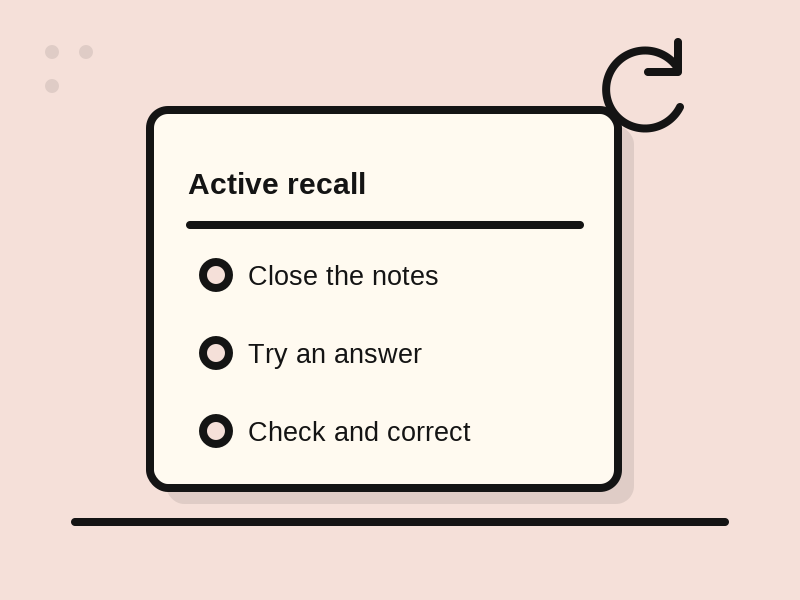
Active recall means trying to retrieve an answer before looking it up. With notes, the practical routine is simple: turn a heading into a question, close the explanation, answer from memory and then check what you missed.
Research on retrieval practice supports testing yourself as a learning activity. The Purdue Cognition and Learning Lab summarises this work and links to the underlying studies. The routine below is a practical starting point, not a promise of a particular grade or an optimal schedule for every subject.
Turn a topic into an answerable question
A heading such as “Project risk” is a label. “How does a risk differ from an issue, and what would I do with each?” is a question you can attempt. Add a concrete example so you have to apply the distinction.
Use different question types: explain a concept, compare two similar ideas, work through a calculation or decide what a scenario implies. Match the question to what your course expects you to do. A definition-only routine will not fully prepare you for an assessment that asks for analysis.
Try a short closed-note round
- Select three questions from one topic.
- Close the source note.
- Write or say an answer to each question.
- Mark where you guessed or could not explain your reasoning.
- Open the source and correct the answer.
A spoken response can be useful when writing everything would slow the session. It still needs checking. A fluent explanation may omit a condition or confuse a similar term, so compare the substance with the source.
Record the correction, not just the score
Question: How does a risk differ from an issue?
My answer: Both are current problems.
Correction: A risk involves uncertainty; an issue is already present.
New example: Possible venue closure versus a confirmed cancelled booking.
Source: Course notes, uncertainty section.
Next check: Explain the distinction using a delivery example.
The new example helps reveal whether you understand the correction or have memorised the original sentence. Keep the explanation short enough to review. A mistake log can collect these entries across topics.
Revisit material across sessions
Make room to return to earlier questions instead of only studying new notes. As a starting routine, revisit difficult questions in your next session and mix some older questions into later sessions. Adjust the timing to your course, deadline and performance.
Do not treat a single successful attempt as proof of lasting understanding. When a question becomes easy, change the scenario or ask yourself to explain why a tempting alternative is wrong. If it remains difficult, return to the source before generating more practice material.
Keep questions and answers apart
Put the questions in one note and the checked explanations in another, or use a clear divider and stop before the answer section. The important part is attempting the answer before reading it.
In Thoughts AI, you can keep these notes in a course project and use voice or text capture for your response. This is a manual study routine. Use a calendar or dedicated study tool if you need automated review reminders; a date written in a note is only a record.
For multiple-choice practice, follow the notes-to-MCQ guide. For longer lectures, first make a study guide from lecture notes so your questions follow the course’s actual learning goals.
Frequently asked questions
Can I use active recall without flashcards?
Yes. Answer a question aloud, write a short explanation, solve a problem or sketch a process before checking your notes. Flashcards are one possible format.
Should I only practise the questions I get wrong?
Give difficult questions extra attention, but revisit older material too. Use a new example occasionally to check whether you understand the concept beyond its original wording.